
What should a graduate of Pershing County schools be ready for, not just on commencement day, but ten, twenty, even thirty years down the road?
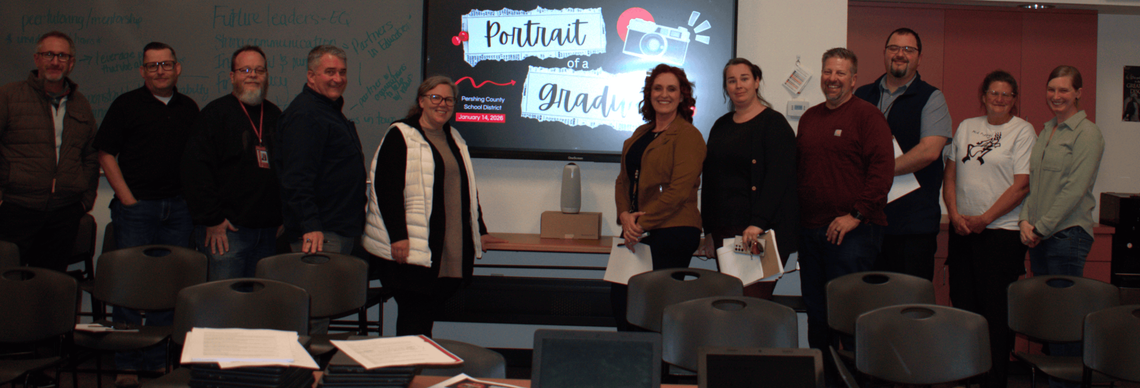
That question sat at the center of a wide-ranging community conversation last week as teachers, administrators, parents, and community members gathered at the Pershing County School District office for a meeting of the district’s Portrait of a Learner committee.
Led by Pershing Middle School Principal Shea Murphy, the meeting marked another step in a long-term effort to define the skills, values, and experiences students should carry with them after graduation, whether they head to college, enter the workforce, or return to raise families in the community.
The group agreed on a guiding phrase that captures the intent of the work: “Ready to learn. Ready to lead. Ready for life.”
Murphy shared results from a recent community survey completed by 177 respondents, including parents, students, school staff, business owners, senior center members, and other residents.
Across age groups and backgrounds, the message was consistent. The community wants graduates who are kind, hardworking, ethical, strong communicators, community-minded, self-sufficient, and prepared for adult life.
One theme that surfaced repeatedly was the importance of recognizing multiple paths to success. Committee members emphasized that not every student needs — or wants — a four-year degree, and that the district should more intentionally expose students to careers in trades, industry, and local businesses. Developing partnerships with employers and organizations across the region was identified as a key next step, allowing students to see possibilities they may not encounter otherwise.
Parents also raised the desire for expanded advanced placement opportunities at the high school level, giving students a chance to earn college credit before graduation while still maintaining flexibility for those pursuing other options.
Throughout the discussion, participants acknowledged that changing culture takes time and patience. Several speakers noted that while today’s students may benefit immediately, the full impact of the Portrait of a Learner framework could take decades to fully show itself.
“That’s the long game,” Murphy said, noting that students who experience these expectations early are more likely to grow into engaged community members and parents themselves.
Equity and access were also central to the conversation.
Committee members spoke candidly about the realities facing students who live far outside town, some traveling more than an hour each way by bus each day. For those students, requirements such as after-school community service can be difficult, if not impossible, due to distance, transportation, and family circumstances.
The group stressed the importance of building meaningful opportunities into the school day whenever possible, experiences that all students can access regardless of where they live or what resources their families have. Mentorship programs, cross-age learning, and partnerships with community organizations were cited as ways to meet students where they are.
Several participants shared past examples of what this could look like, including high school students serving as mentors to younger students, art ambassadors working with elementary classes, and cultural programs that brought local traditions directly into the schools.
As the meeting progressed, the committee revisited and refined the core values at the heart of the Portrait of a Learner framework. The group worked through how to balance concepts like responsibility, accountability, integrity, and ethical decision-making in language that is clear, age-appropriate, and inclusive while still holding high expectations for student character and growth.
Participants emphasized that students should understand not only what is expected of them, but also that support exists when they struggle or make mistakes.
Looking ahead, Murphy outlined next steps, including further word-smithing of the core values, outreach to community organizations to invite them into formal partnerships, and decisions about when and how to publicly launch the Portrait of a Learner initiative. Options discussed ranged from a website rollout later this spring to a larger community unveiling tied to the start of the next school year.
The committee also discussed the importance of being clear and specific when inviting partners to participate, not just asking organizations to support education in general, but identifying concrete ways they can engage with students.
By the end of the evening, the tone was clear: this work is not about a single program or quick fix, but about shaping an educational culture that reflects the realities and values of Pershing County.
“This is important work,” Murphy said in closing. “Because at the end of the day, it’s about our kids and doing the best we can for them.”
The committee is expected to reconvene in April, when further decisions will be made about partnerships, program structure, and public rollout.





Comment
Comments