
As northern Nevada positions itself for continued economic growth, one question loomed over discussions at this year's Western Nevada Development District summit: Can the state generate enough energy to support it?
From mining operations to manufacturing and rapidly expanding data center development, demand for power is rising — and quickly.
Energy leaders at the summit described the scale of that demand as unprecedented.
In fact, officials noted that the new power demand requested across Nevada far surpasses the capacity the system has taken more than a century to build.
"Our entire system in Northern Nevada is right around 2.5 gigawatts — 2,500 megawatts," said Jeff Brigger, a representative with NV Energy. "It took us 125 to 130 years to get there. We currently have 22,000 megawatts — 22 gigawatts — of requested loads in our Northern Nevada service territory. This is massive in scale, and it takes time to build."
Much of that demand is driven by large-scale industrial and technology projects, including data centers that require vast amounts of electricity.
Unlike traditional industrial users, data centers often require highly reliable power systems with multiple transmission lines and backup capabilities, adding complexity to infrastructure planning.
Meeting those needs, speakers said, will take time — and significant investment.
Beyond electricity, natural gas infrastructure also plays a role in supporting large projects.
Daniel Pace, the Key Accounts and Energy Solutions Supervisor for Southwest Gas, described the challenge of not only generating power, but delivering it — requiring coordination across pipelines, transmission systems, and local distribution networks.
"It's important to understand how you go from your normal industrial customer to a customer that needs 500 megawatts, or 1 gigawatt, 1.5 gigawatts of power," Pace said. "You can think of it like a straw. There's only so much that can move through it at a time."
To address these challenges, utilities and state agencies are working with developers to plan long-term solutions, including new transmission lines, expanded capacity, and, in some cases, on-site power generation.
Pace also emphasized that growth must be balanced with reliability for existing customers.
"We want system reliability, but not at the sacrifice of our existing customers."
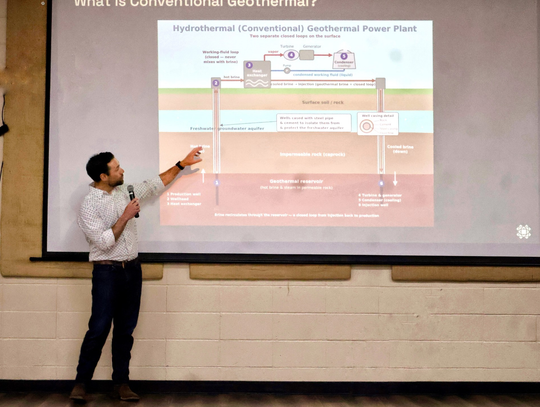
Looking further ahead, some discussions turned to emerging energy technologies — particularly nuclear and fusion energy. While these options are often discussed as long-term solutions, experts cautioned that they are not yet ready to meet current demand.
"Fission is the current nuclear industry that we have right now," said Fred Dilger, executive director of the Nevada Agency for Nuclear Projects. "It requires enormous lead time, capital investment, and creates a great deal of waste. Nevada doesn't want any part of any of that."
Dilger noted, however, that a different kind of nuclear energy, fusion, offers fewer drawbacks and is advancing rapidly; fortuitously, Nevada has a notable amount of an element needed for its use.
"One key element that you need to make fusion work is lithium. If you are a state that has a lot of lithium or a functioning lithium mine, you're very, very well poised to be a part of that."
To get ahead of this encroaching nuclear technology, Dilger stated he has communicated its potential to the governor, and they're putting together the regulations necessary to make fusion machines work in Nevada.
That reality leaves Nevada in a familiar position — balancing opportunity with limitation.
The state continues to attract interest from companies looking to build and expand, drawn by available land, business-friendly policies, and access to key infrastructure.
But as summit participants noted, sustaining that growth will depend on careful planning, strong partnerships, and a clear understanding of what resources are available — and how quickly they can be expanded.
For many in attendance, the path forward is not about slowing growth but managing it.
Glen Martel, the city manager for Carson City and moderator of the energy panel, echoed this sentiment and shared, "We want to do things right, but we know we're going to hit some obstacles. We're going to press through; we're going to make sure that Nevada and our communities within Nevada are better in the future than they are today."




Comment
Comments